
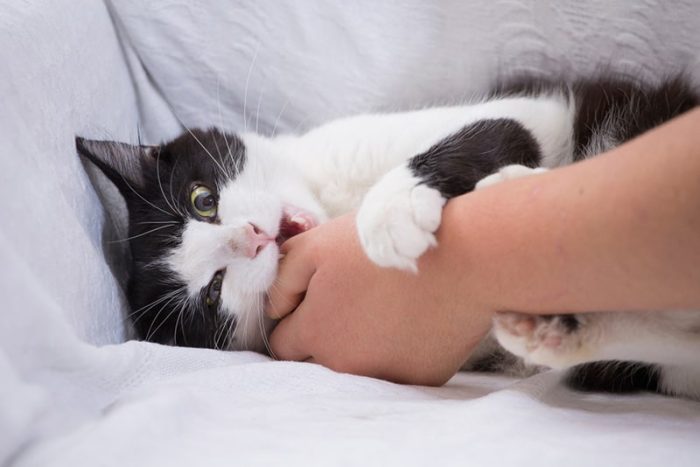
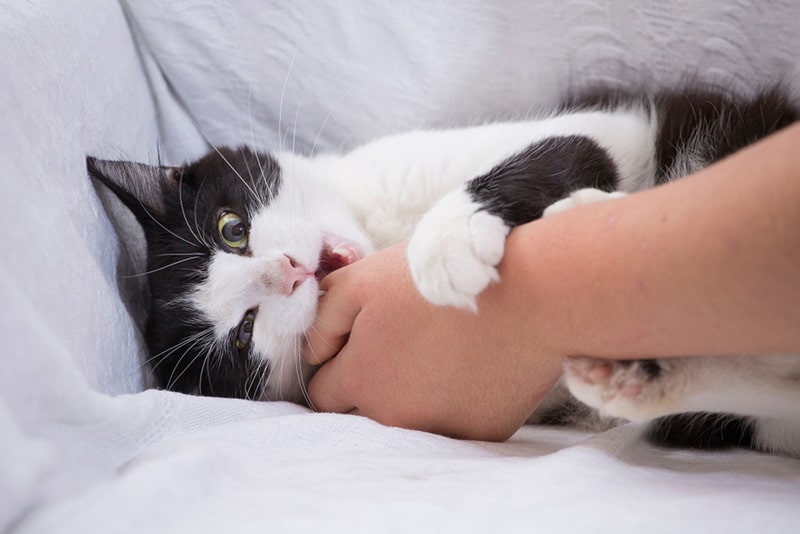
Cat bites sent more than 400,000 people to emergency rooms in the US each year.1 Not scratches. Bites. And the reason they’re so medically serious has nothing to do with how hard the cat bites. It’s about what’s in a cat’s mouth and what happens once those small, deep punctures seal shut.
Most cat owners know biting is a problem they should address. Fewer know that the way most people instinctively respond to being bitten actually makes it worse. And almost nobody thinks to ask why their cat is biting in the first place, which is where any real fix has to start.
Why Cats Bite: It’s Rarely Random
Cats don’t bite out of nowhere. There’s always a reason, even when it doesn’t look like one from the outside.
Kittens bite mainly through play. In a litter, rough play teaches social boundaries. Biting too hard gets a sharp reaction from a sibling, and the kitten learns to moderate. When kittens are separated from their litters too early, they miss that feedback, and the habit transfers to their humans instead. What feels like innocent play nipping at eight weeks becomes a genuinely painful problem at eight months.
Adult cats bite for a wider range of reasons. Attention-seeking is one of them. When a cat is hungry, bored, or wants contact, biting is an effective way to get a response, and if it works even occasionally, the cat learns to keep using it. Territorial assertion and overstimulation are also common triggers. Many cats have a limit to how much handling they’ll tolerate, and they will give warning signals before biting. The problem is that humans often miss or ignore those signals until the bite happens.
Fear and stress are significant contributors. A cat in a cortisol-driven fight-or-flight state will bite defensively, and if biting has previously gotten them out of something unpleasant, such as nail clipping or a vet visit, they remember that and use it again.
Pain is a cause that owners frequently overlook. A cat that bites suddenly when you touch a specific spot may have an injury or internal condition you can’t see. If biting behaviour is new and unprovoked, ruling out a medical cause at the vet before attempting any behaviour training is the right move.

What Makes Cat Biting Worse
Before we get to what works, it’s worth knowing what doesn’t – because some of the most common responses to cat biting actually reinforce the behavior.
Pulling your hand away sharply is the single most counterproductive thing you can do when a cat bites. It mimics prey trying to escape, which triggers the cat’s instinct to bite down harder. Instead, push your hand gently toward the cat’s mouth. It sounds wrong, but it catches them off guard and usually prompts them to release.
Shouting or physical punishment frightens cats and damages your relationship without teaching them anything useful. Shouting can be read as rough play and reinforces the behaviour. Physical punishment can trigger stress-related problems, including withdrawal and litter box avoidance. Punishment doesn’t work on cats the way it might on other animals.
Using your hands or feet as play objects, even occasionally, teaches the cat that hands are fair targets. They will act on that lesson at unpredictable moments. This includes letting kittens “play bite” because it seems harmless when they’re small. The behavior doesn’t go away as they grow.
Inconsistent responses across the household undermine any training. If one person exits the room every time a bite happens and another laughs it off and keeps playing, the cat receives mixed signals, and the biting continues. Everyone needs to respond the same way, every time. Visitors should be briefed as well.
What Actually Stops Cat Biting
Leave immediately after a bite. After gently pushing your hand toward the cat’s mouth to prompt release, leave the scene. Don’t shout, don’t shove, don’t engage. Simply leaving, consistently, every single time, sends the clearest message the cat can receive: biting stops all play and all attention immediately.
Redirect to appropriate toys before biting happens. Keep a variety of interactive toys available so the cat doesn’t lose interest. The goal is to redirect the urge to pounce toward something appropriate before the cat even gets to your hand. Wand toys, kick toys, and puzzle feeders all give cats an outlet for their predatory instincts.
Use positive reinforcement. When your cat uses a soft paw instead of biting, redirects to a toy, or solicits attention without nipping, reward that immediately with a treat, calm praise, or brief affection. You’re teaching them that the gentler behaviour gets them what they want.
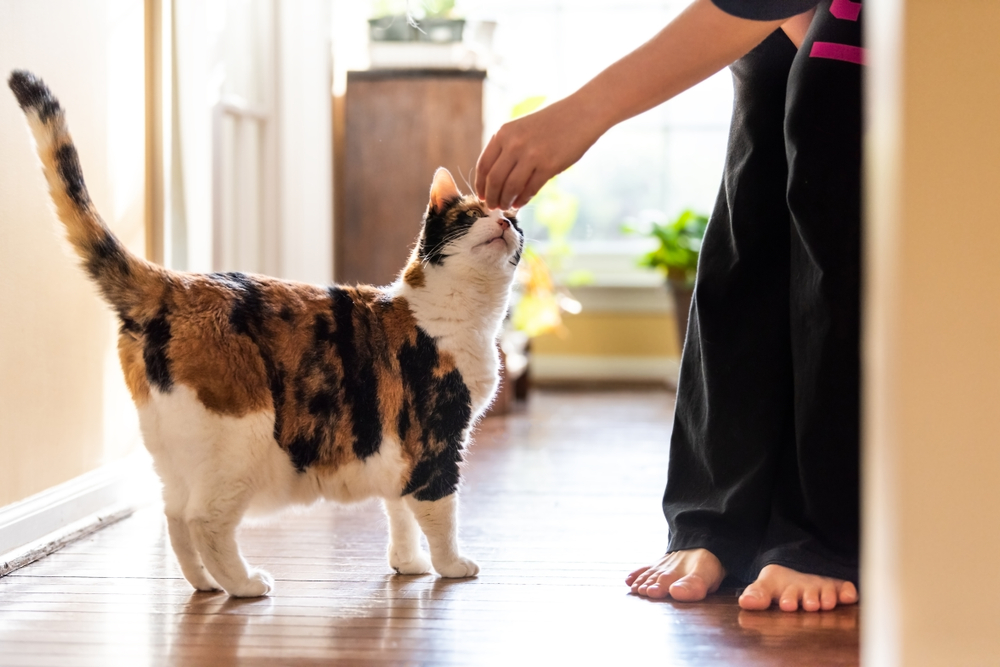
Keep your cat’s routine consistent. Cats act out when bored, under-stimulated, or stressed by changes in their environment or schedule. Predictable mealtimes, regular play sessions, and a private retreat space reduce the baseline anxiety that often underlies biting. Mental stimulation is part of this, too. A cat that has had enough outlets for its predatory instincts during the day is far less likely to redirect that energy onto you in the evening.
Consult a vet if nothing is working. If the biting is severe, sudden, or not responding to training, see a vet. Pain, illness, and unresolved stress all show up as aggression. A vet can rule out medical causes and recommend calming supplements or other interventions if anxiety is a significant factor.
If you need to speak with a vet but can’t get to one, head over to PangoVet. It’s an online service where you can talk to a vet online and get the advice you need for your pet — all at an affordable price!

What to Do If You Get Bitten
Cat bites are more medically serious than they look. The punctures are small, close over quickly, and trap bacteria inside. Pasteurella multocida is present in 70 to 90 percent of cats and is one of the most common culprits in bite infections. If bitten, press on the wound to encourage flushing, wash thoroughly with soap and water, dry and dress it, and see a doctor. Watch in the following days for swelling, redness, oozing, increasing pain, or fever. Any of those signs means the infection is spreading and needs prompt treatment.
It takes time and consistency to change a cat’s biting habits. But it is very achievable, at any age, with the right approach.
Featured Image Credit: Luis Echeverri Urrea, Shutterstock
Did You Know?
Source: www.catster.com